Wednesday, October 12, 2011

Happy Anniversary!


Happy Anniversary....to our blog. Yep, October 7th, 2010 I wrote about the perfect fall day in Minneapolis and about how special our community is back home. Can you believe that we still hadn't decided on a country at the time (2 months pre-departure! Yikes.)? Anticipation was building but so was the awareness of what we would be giving up for a year.


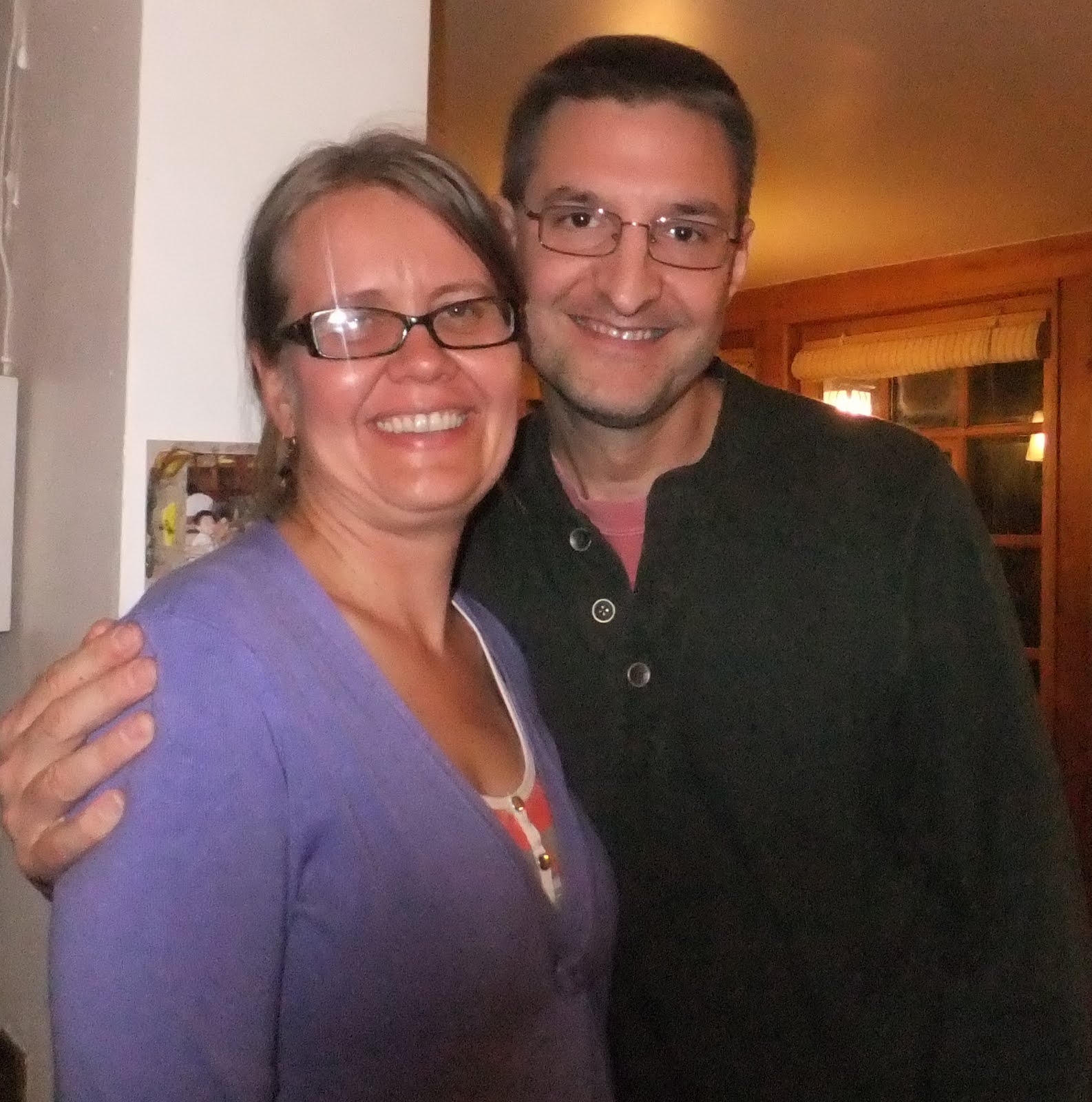


So, what better way to mark this anniversary than spending time with some of our great friends from home and from Chile!

Last Thursday our dear friends, Jenny Breen, Jon Dicus and their girls Solana and Franny pulled into town for the long Columbus Day weekend. They are neighbors, fellow frisbee players, we've worked together in the community, and our kids have been close since Gracie and Solana started sharing babysitters at 6 months of age.


They just moved to Mendoza, Argentina in July to start their one year sabbatical, similar to us (Check out their awesome blogs Cooking Up the Good Life and Argentina Adventure.

Just a year ago, all eight of us would gather over dinner or tea and dream about whether we could pull it off - one year in Latin America with the kids. Jon and Jenny, like us, had dreams of their girls not just learning Spanish, but living it. We all wanted to be immersed in another culture and find our way to be part of that community. And here we all are.

It was so great to check in with these guys: to compare notes, to laugh about the funny situations we find ourselves in and to empathize about the challenges. Long into the night, as we adults were reluctantly saying goodnight, we could still hear Solana and Grace chatting about everything as well.

We basically talked all weekend - thrown in was lots of cooking and good eating (Jenny is a chef; check out her new cookbook!) and some wandering around our favorite haunts in Valparaiso (the beach, the funiculars, our favorite ice cream shop, bungee jumping on a trampoline, etc...).

We had a great typical Latin American dinner, hosted by our dear friends Cecilia and David, in which you gather around 6pm, but then there's lots of talking, drinking wine, and eventually cooking and eating maybe around 11pm, until finally its time to go because its almost 1am and the kids are all falling asleep! We caught some live music and attended the Mil Tambores parade (more on that next).

When we went to Cecilia and David's, we suggested to our four kids that they play in Spanish that night, so as to include the Chilean kids. Theo responded, "Yeah, yeah Mom. No problem". Nothing like looking back to realize how far we've all come.

-Laura

p.s. Thanks to all of you who have been reading the blog this last year. Some quick blog stats:
- page views total: 27,554
- post with all time most page views: Theo's "Ayúdame" Halloween candy advice-seeking post last October with 181 views.
-Four out of five of top page view posts were written by Grace or Theo...hmmm...I can take a hint.
-Number #1 referring site: Facebook, hands down.
- Audience sources: 10 countries, #1 US, mystery audiences: Russia (45 hits) and Germany (41)??? (who are you?)

Wednesday, October 5, 2011

p.s. It was a good day today - according to Theo.

Probably, I overreact and this is all normal in the course of kids' lives. I think our elementary school at home does such a good job at creating a positive community for all the kids - that we get spoiled and forget how common acting mean to other kids or bullying can be.

Anyways, I asked Theo about his day and he shrugged shoulders and said, "Estuvo bien. Normal." Yeah for good and normal days.
-Laura

Stranger in a Strange Land


Yesterday Theo had an awful day at school. Some of the kids in his class were excluding him and being mean to him. It breaks my heart. We're hoping today is a better day. It does seem that there's mostly "good days" and then a bad day will happen. Its hard to know how much Dan and I should intercede and how much to try to give Theo the tools to deal with mean or exclusive behavior - which unfortunately he will encounter in different forms all his life.

I think part of why this happens in Theo's class has to do with elementary school boy culture, which left unchecked isn't characterized by being nice and inclusive. I do think the teaching staff are proactive about counteracting it, but I don't think the other parents are involved around these topics. I think part of it also has to do with the fact that there are so few students in Theo's class - 11 in all and only one girl, which means there aren't a variety of friends' groups. Instead, there's one group and those who are left out- which changes from day to day. I think also that we opted for a school that hasn't had much exposure to foreign students. In terms of immersion this has been great, in terms of embracing and empathizing with kids that are different, from a different country, that speak a different language there has been a lack of knowledge, experience, and sometimes empathy in particular among Theo's classmates.

I think that until you have lived abroad, away from family and friends, its hard to understand what that experience could mean. Our friend Jenny, who along with her family have recently embarked on their own year abroad in neighboring Mendoza (and who will be visiting this weekend!!!!) recently wrote on her blog about gaining a new empathy for folks that have been removed from their communities. She writes,

"I am developing great empathy for all of the ‘outsiders’ in our own world. The parents whose kids enter our school without understanding how to navigate the system. That is, be both the formal school system, and the more elusive informal system of friends, play dates, book clubs, weekend get-togethers and carpools. The transplants who move from other parts of the world and try to settle in to the rhythms of a foreign place with all of it’s idiosyncrasies-the weather, the nightlife, the bus schedule and housing, and the language-what an incredible barrier that can be!".

I think that all these factors can be true in any country. Certainly, all these factors happen in the US too. But I also think that a country that has lived under a violent dictatorship that ended only 20 years ago, still has healing to do. I am doing a series of interviews for a nonprofit project I am working on here, and I was talking with a school leader this week about the community she grew up in. She still lives in that community, but talks of pre-dictatorship and post-dictatorship in very different terms. She explained that when she was a child, all the children played out in the street, safe with many neighbors watching over them. During the dictatorship Chileans headed inside, there was a state of emergency at night, it wasn't safe to be out, neighbors became informants regarding other neighbors sometimes as the only way to save themselves. People, sometimes children, were disappeared by anonymous groups working for the military. My interviewee explained that Chileans learned to fear and distrust their neighbors and today children still often arrive home and stay inside. Perhaps as a result, Chile can be an insular society at times. As one of the Chilean disabled adults at the recent training workshop I attended stated, "Chile is an exclusive society" - exclusive in terms of low tolerance for outsiders or those who are different. Whether that generalization is true or not, we're thankful that at least as a family we have made many good friends here, but it is true that many of them are Chileans that have in fact lived abroad previously.

I hope that one of the many life lessons of this year for our kids will be around empathy for those who are different and the importance of inclusivity. I know that has often led me to work or volunteer with recent immigrants in the US. I know when people here invite us to dinner or let us know about an event happening or simply ask us about how we are doing, it means everything to us. Here's hoping for more "good days".

-Laura

Saturday, October 1, 2011

Participatory Facilitation Chilean style & Don Francisco!

For those of you who have worked with me either at Joyce Preschool or Lyndale Neighborhood Assocation, you will remember well the ubiquitous purple sticky wall! The purple sticky cloth is a tool used by TOP (Technology of Participation) and ICA (Institute of Cultural Affairs) along with a whole bevy of other wonderful facilitative tools and methods that foster maximum group participation and general gleaning of group wisdom.

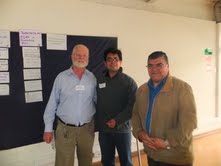
I love these methods, so I was thrilled to be connected to the Chilean ICA team of facilitators. This week, I ran off to Santiago for a couple days to mostly observe a training workshop I'm very familiar with, but in Spanish! Very cool. In addition, the Chilean ICA team has focused their efforts on working with adults with disabilities. A group that is very marginalized, particularly professionally, in Chile. It was a very powerful experience.

I wasn't able to observe the entire workshop, as responsibilities back in Valparaiso called, but I'm hoping I'll be able to help out with another workshop before the year is out.
-Laura

p.s. On a side note, my gracious hostess in Santiago - Ana Mari Urrutia, also took me for a tour of La Sociedad Pro-Ayuda al Niño Lisiado or now known as the Teletón. It is a multi-million dollar organization which has clinics all over the country which treats handicapped children. She had been director for many years and her father was the original founder. Anyways, it was a great tour and we were there for the day of the Teletón kick-off, their big fundraising event. Why I am telling you all this? Because for all of you that have seen Sábado Gigante, which has been on Latin American television for the last 50 years, will be interested to know that the organizer and face of the Teletón is none other than Don Francisco, or Mario Kruetzberger, a Chilean, who I had the pleasure meeting this week! To give some context for those of you unfamiliar with Don Francisco, it was kind of like meeting the Latino Bob Barker.

Wednesday, September 28, 2011

Bailes Típicos and Great Traditions


When we were in Lima in July, we went to a special buffet lunch as guests of Victoria Campoverde's family (one of my former teachers at Joyce Preschool). It was a delightful day and included with the lunch (which last for several hours) is a show that highlights some of the typical dances from each region of Perú. I was incredulous that the entire restaurant full of Peruvians all knew the lyrics to all the songs and the dances (as was obvious as volunteers from the crowd were pulled up to dance).

Well, so it goes in Chile. I think it's one of the coolest traditions. Every year at fiestas patrias time (independence days parties) all the school children learn a different regional dance and perform it in traditional costume.

Our kids had so much fun. Theo danced the "Costillar" from Chiloe and Gracie danced the typical "Cueca" from central Chile. We all are singing the "costillar" song - or humming as the case may be -since Theo is the only one that knows all the lyrics.

It was a lot of fun and all the kids did a fantastic job. Here are some photos (I'll see if I can get Dan to put up the video) of their dances.
- Laura

Monday, September 26, 2011

¡Apagón!

The ships in the harbor, and a few emergency lights, were all that was shining Saturday night.  Photo from UPI, via here.

It's been quite a year to be here in Chile.  Violent protests, massive demonstrations, student strikes, a tsunami alert, a soccer game cut short by tear gas and riot police, and earthquakes strong enough to wake us from a deep sleep.  What's next, you might ask?  How about a massive, nearly nationwide electrical blackout affecting more than 10 million people?

It's kite-flying season here in Valparaíso, with 15-20 knot winds almost daily.  But it was a beautiful calm evening on Saturday when the lights went out.  As we looked out our window we saw only darkness in the city below, and as we watched the lights of Viña del Mar, the city up the coast, dimmed and flickered out as well.  An ominous red glow flickered above the mountains to the north, over the oil refineries and power plants of Ventanas.  Uh oh.

We filled up water containers, and dug out an FM radio, anticipating a long outage.  The radio confirmed that the capital, Santiago, was also dark, as well as smaller cities up and down the country.  There was no indication of what might have gone wrong.  We sat around the candle and told stories from power outages and storms of the past.

But then, an hour or so later, the lights came back on.  Two days later, the news is still reporting only 'instability in the power grid' as the cause, and small regions up and down the country continue to have brief unexplained blackouts.  And we find ourselves wondering again, what's next?